
New report highlights customer experiences from REAL Programme Catalyst Energy-as-a-Service pilots
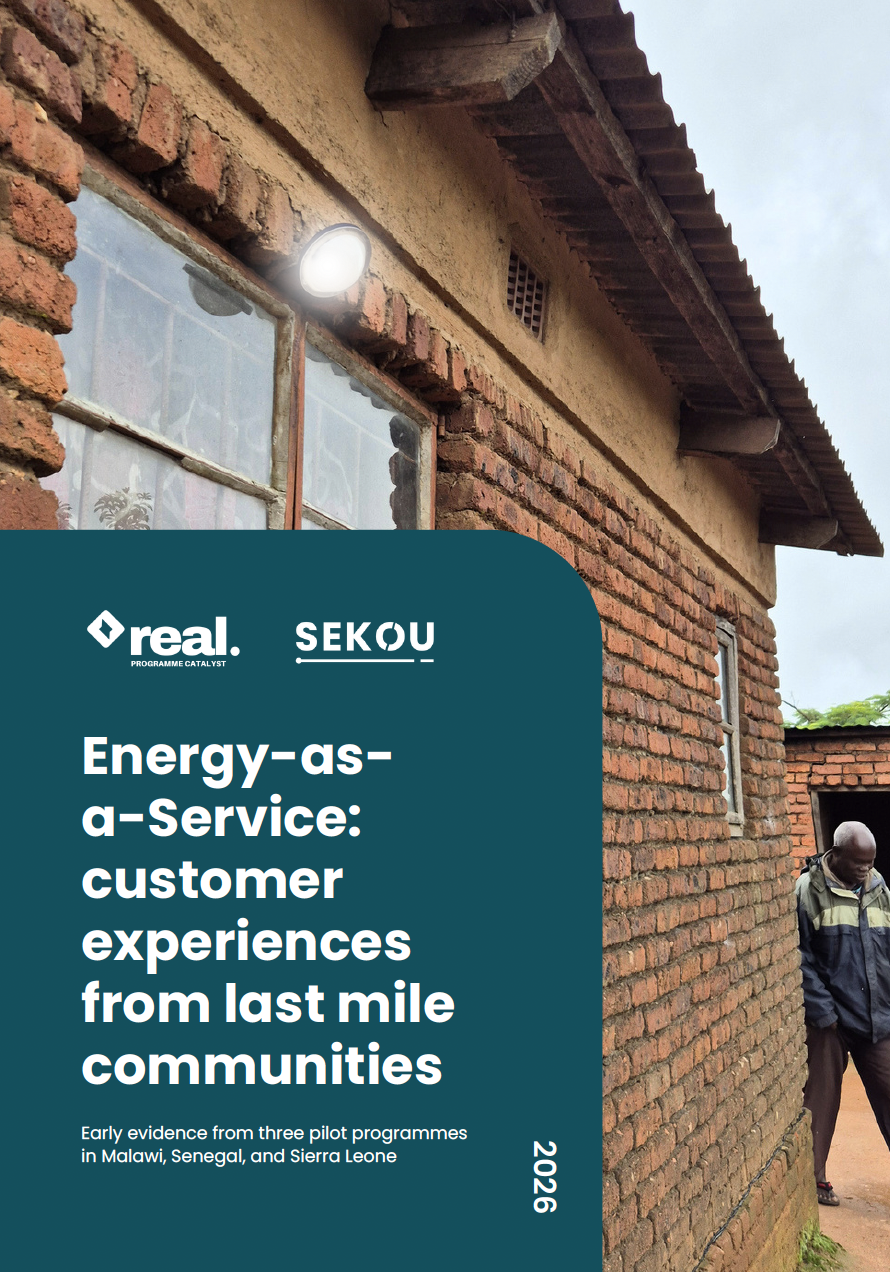
Customer surveys provide new insights and data on improvements in lighting and phone charging, impacts on daily life, and customer experiences of payment processes from our Energy-as-a-Service (EaaS) pilots, as detailed in a report by consulting firm SÉKOU.

Photo Credit: Moon, Senegal.
REAL Programme Catalyst, in partnership with consulting firm SÉKOU has published a new report offering early insights into customers’ experiences of our Energy-as-a-Service (EaaS) model. Drawing on independent survey data from pilot programmes in Senegal, Sierra Leone and Malawi, the report highlights both the impact and the potential of a service-based approach to delivering solar home systems (SHS) at scale.
Around 600 million people in rural sub-Saharan Africa still lack access to energy, a challenge that continues to limit opportunities for education, healthcare and economic development. The report underscores how deeply this issue is tied to affordability, infrastructure gaps and the remoteness of many communities.REAL Programme Catalyst’s model aims to tackle these barriers head-on by treating energy access as essential infrastructure, delivering SHS through a truly affordable regular service fee, rather than requiring upfront purchase.
The findings, based on surveys of nearly 600 households, point to meaningful improvements in everyday life within just four months of installation.
Access to lighting has increased significantly across all three countries, particularly in Malawi and Sierra Leone where baseline access was lowest.
In Malawi, reported daily lighting hours rose from just three to twelve, while Sierra Leone saw an increase from ten to fifteen hours.
These gains are not merely technical—they translate into more time for study, work and household activities.
The report also highlights improvements in connectivity and convenience. In Malawi, households previously travelled an average of six kilometres to charge their phones; this need has largely been eliminated.
Across all pilot countries, customers report that the service offers good value for money, with over 90% noting an improvement in their quality of life.
High Net Promoter Scores—ranging from 89 to 97%—further reflect strong customer satisfaction.
Importantly, the report does not shy away from challenges. Payment difficulties vary across contexts, with higher levels reported in Malawi, pointing to the need for continued refinement of payment systems and consideration of local income patterns. Some users, particularly in Senegal, also noted limitations in system capacity.
Overall, the report provides compelling early evidence that the EaaS model can deliver reliable, affordable and scalable energy access to some of the hardest-to-reach communities.
By removing upfront costs and ensuring ongoing maintenance and support, REAL Programme Catalyst is helping to build a more inclusive pathway towards achieving truly universal energy access.
